|
||||||||||||||||||||||||||||||||||||||||
| ECHC Main > Archives > 2002 Features > HyperFest - ECHC in front of 3500 fans! | ||||||||||||||||||||||||||||||||||||||||
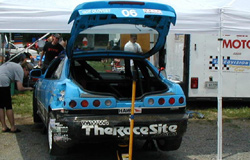
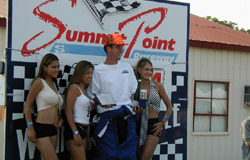
ECHC puts the Hyper in HyperFestScott LearIt's only 7:00 on a Saturday morning, and the air hanging over West Virginia is as comfortable as it's going to be all day. Thick and humid, it's enough to make me consider turning on the A/C for the drive in; but there's no sense in getting used to cold air when I'm going to be spending at least 16 hours in the heat. Besides, turning on the AC is like taking a cylinder out of a 4-banger Honda, and it's blasphemy to intentionally sap power while enjoying winding roads like the ones that lead to Summit Point. At the gate, a group of people who are remarkably cheerful for 7:00 AM give me my wristband, a brochure detailing the layout and schedule for HyperFest 2002, and a small card with information about the National Auto Sport Association (NASA) East Coast Honda Challenge (ECHC). HyperFest 2002 is one part import car show, two parts high-performance driving event, and two parts racing. Drift, burnout, rollover, and bikini contests are thrown in for seasoning. All are cooked (quite literally during the extremely hot weekend) for two days in late June at a 10-turn road course known for its challenging mix of fast and technical sections. HyperFest is aimed at the import enthusiast, and a number of different Hyper Events have been set up to coax the street scene out on track. Hyper-Cruise is for those who want to take their cars out on track at safe (boring) highway speeds. Hyper-Slide lets you beat up a retired police cruiser on the wet skidpad at Summit Point. Hyper-Ride is a chance to experience the driving (antics) of professional instructors as they do their best to scare you by drifting, bumping into other instructors, locking up the brakes at corner entry - all things they'd yell at you for if you tried them during a Hyper Drive, where you drive your own car at its limit with an instructor in tow. For those interested in dedicated track time, a more intensive time-trial event (called, shockingly, Hyper-Trials) gives students a full day of instruction and on-course experience at Jefferson Circuit, a smaller road course adjacent to Summit Point. But these are just appetizers for the main event of the weekend: Races 3 and 4 of the inaugural season of the East Coast Honda Challenge. The card I received coming through the gate reads: "The series philosophy is a simple one. The East Coast Honda Challenge is a motorsports showcase for Honda automobiles in a clean, sportsmanlike racing environment. In short...Marque Club racing for Hondas." The series has been set up with six official classes, H1 through H6. H1 cars are the ones with the best power-to-weight ratios and extreme performance envelopes, like the NSX, S2000, and high-powered hybrids (no, not the Insight; hybrids in the Civic-hatchback-with-an-Integra-Type-R-motor sense of the word.) H6 cars are the least powerful 1.5 liter carbureted Hondas of yore. This weekend, H-Unlimited (HU) has been set up to allow a pair of extremely tuned cars to participate, though they will not be eligible for points. Any other Honda or Acura you might want to race falls into one of the classes, and there is quite an assortment in the paddock.
"Hey, Captain Ruleboy!" someone with a question shouts towards Karl Shultz (#78), co-founder of the ECHC and the man in charge of rules for the series. This elicits laughs from those in earshot, and it is decided that Captain Ruleboy is an appropriate name for Karl when rules are to be questioned henceforth. Many of the drivers are already clad in their Nomex driving suits. For those who have not had the pleasure, Nomex is a fire-retardant material that paradoxically becomes hot as hell when you're wearing it, particularly when it's already hot as hell outside. The majority of drivers have the upper part of their suits tied at their waists; there will be plenty of time to overheat once they're strapped inside a metal box with a hot engine covered in layered Nomex from head-to-toe. The PA system announces that it's time for the mandatory Drivers Meeting, and the ECHC gang file into a meeting room near the paddock.
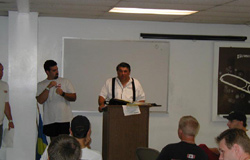
Grumpy (reading roll call): "Scott Giles?" Scott Giles: "He's an ass!" The group chortles. Grumpy: "David Rhodes?" David Rhodes (in his best Marine Corps grunt impression): "SIR YES SIR!!!" More laughter. Grumpy starts the meeting by confirming that the Formula Light and Formula 2000 open-wheeled racers who were to share the spotlight this weekend have canceled. "This means you guys are the feature show. You are the ONLY show. Hence, you are the best show." Grumpy touches on the important topics for the weekend, like required decals for the cars, transponders for timing, safety inspections. Grumpy says he will impound all the cars at the end of practice to check for any safety violations. "I want to see the car as it was on the track, not after you've fixed it. Safety is paramount. What we do is very dangerous." He then glosses over the flag rules that these drivers already know intimately from earning their competition licenses. Repetition of safety procedures is never excessive, but he does keep it interesting. "This is the debris flag," Grumpy says holding up a red and yellow striped flag. "This is for when there's oil, gas, snakes, groundhogs..." the group laughs, and someone asks about a deer. "If there is a deer on track, there will be a yellow flag." He holds up the yellow caution flag. "If the deer leaves anything behind on the track" the debris flag comes up, and laughter again fills the room. Grumpy hands control of the meeting over to Scott Giles with a heart-warming "Aright, this guy wants to yell at ya. You'll know him by this flag." A blue flag with a red stripe, which warns a driver that he is about to be overtaken by a faster car, is raised by Grumpy. The crowd lets out an appropriately fake "ooOOOooohhh!"
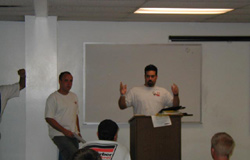
Karl is in charge of protests, and he informs the group that the "Here to Race Too" rule will apply to protests. He then expresses his own interest in a safe weekend. "Who here wants to see their car leave in different shape than it is now?" "I do!" yells a racer with a car that is already beat up, implying that any incidents might actually improve the condition of his vehicle. "Yeah, you and Warren!" replies Karl, referring to Wang’s thoroughly wrinkled Type R. The meeting ends, and drivers scurry to their equipment so they can get as much practice time as possible. At 9:16 AM, the course is clear and green, and the 1-minute to grid release warning is given. I hear this on a course worker's radio from my vantage point at the end of the long straight, inside turn one. This decreasing radius hairpin comes after the hardest braking zone on the course, where cars will be decelerating from nearly 130 MPH before coming hard right at around 60 MPH. The run-off area, which gives drivers some coarse material to plow through before hitting a wall, is quite large. This indicates that trouble is expected here. At 9:18, the distinctive sound of a few unmuffled Hondas can be heard coming out on to the main straight.
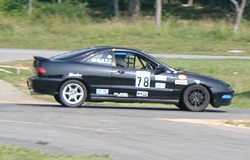
At 9:47 AM, most of the cars have returned to the paddock for post-practice tech inspection. John Whitaker (#88) is beating the snot out of an underbody diffuser/splash guard panel, which reluctantly returns to a functional shape after being deformed somehow. One of the H4 cars is forced to retire at this early stage due to a loss of oil pressure; never a good sign for an engine. The majority of the field is back unscathed, and preparations begin for qualifying. The sun is almost directly overhead at 12:30 PM, and what shadows there are offer little refuge from the sweltering heat. It's time for qualifying, which can yield the fastest laps of the weekend. Drivers will try to get a few perfectly clean laps at 10/10ths of their potential, in a bid for good starting position. I've situated myself along the pit wall that runs parallel to the main straight, where cars can be seen exiting turn 10, a high speed sweeper that connects to the main straight. Corner exit speed here is vital, since every extra bit of speed carried from the exit will translate into that much more speed down the length of the 3000-foot straight. Co-Founder Karl Shultz (#78) blazes down the front straight lap after lap, instinctively tapping his brakes halfway down the straight while still under full throttle, to make sure he still has stopping power. Deep into the entry for turn one at 130 MPH is not the place to discover you have no brakes, and so the check is an excellent habit. Warren Wang (#71) is using every inch of the track, crossing over the red and white curbing and on to the narrow strip of asphalt that is the last chance for traction before the gravel runoff at the exit of turn 10. He is searching for the line that has the most gentle arc, which allows for more acceleration and minimizes the turning that must be done. As the cars come back to the paddock, drivers can be heard expressing their pleasure (and displeasure) at their first timed performance of the weekend. "This sucker is a freakin' rocket!" Corey Jacobs (#20) says of his red generation 4 Prelude, which has perhaps the largest motor in the field at 2.2 liters. "I can pass anyone down the straight."
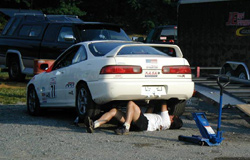
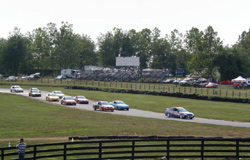
In the afternoon, a small group is attacking the hub spindle nut on Jason Meise's daily driver civic, in an attempt to free the hub for use on James Evans' racecar. Several different brands of breaker arms from other driver's toolboxes have already snapped, and I offer mine for sacrifice. It takes about 3 seconds before the top of my bar has sheared off inside the socket. Well, that's what warranties are for. A few minutes later an airgun is rigged up to the tire inflation hose, and technology makes short work of the stubborn nut. After a long, hot afternoon of making final preparations on their cars and staying cool and hydrated, the first race is scheduled to begin. Most have recommended that I watch the race at the carousel, where several bleachers overlook the most complex series of corners on the track, turns 5-8. Drivers must brake hard into the slowest corner on track (turn 5, a banked left), and then negotiate a smooth line out through turns 6 and 7 (nearly 270 degrees of loop), and finally out to a small left kink, turn 8. The most technical section of the track, this is difficult when on the track alone. With a pack of cars around you all trying to come out in the front, it becomes decidedly more interesting. "Start your engines!" The PA system blares at 5:00 PM. There are too many trees between my seat in the bleachers and the pit lane, but it's not hard to imagine the sound of more than 30 angry Hondas firing up. A few minutes later, the cars come around on their warm up lap, their positions determined by their speed in qualifying. If you have never witnessed a race in person, it is a unique experience. Apart from the more immediate sounds, smells and other sensory stimuli that real life affords, you have a different perspective than a televised broadcast presents. TV tends to focus on one car for several laps. In person, you are focused on a particular part of the track, and the race is more fun for the things you don't know than the things you see. You quickly memorize the running order of the cars, and when they come around the bend in a different order, passes become apparent. When a car disappears for more than the usual lap time, anxiety about its fate dominates your mind. And when an incident does happen in front of you, it's far more visceral.
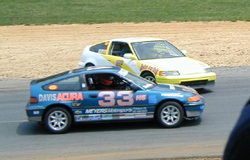
A white hatchback, the #21 Civic of Bill Gleason Jr. comes smoking into turn 5, and slides off the course at the entrance to the carousel and onto the grass. Bill climbs out of the car, and heads towards the safety of the flagging station, his car smoking noticeably. The faster cars have started lapping slower traffic, adding another element to the race. Alex Ratcliffe has passed Corey Jacobs in the battle for H2. John Whitaker (#88) and Matthew Bookler (#33) are all over each other, giving the crowd quite a show. John Martin (#42) spins without incident, and Jedd Fahnestock (#44) narrowly avoids Martin's red CRX. At 5:30, a full-course yellow flag is out, the result of David Rhodes (#50) crashing into the pit wall. The field bunches together behind the pace car, but Rhodes manages to get back on track without a tow truck, so the delay is brief. At 5:32, the field goes green again, and the cars continue their charge. Tom Stewart's (#98) H-Unlimited Civic is on a tear, chirping brakes in the zone before turn 5, and decisively passing lap traffic, well in the lead for the overall race. A few laps later, the checkered flag flies.
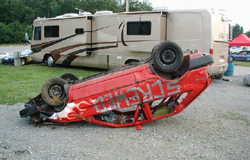
Morning on the second day of the HyperFest is much like the first, but drivers are a bit less active this morning. Most have camped out in the paddock, and there was no shortage of partying in the warm night air. As the man behind the microphone for the weekend, David Teague is required to sound upbeat and awake at any hour. Everyone has latched on to the Hyper-Running Joke of the weekend, and his first announcement Sunday morning reflects this; "I know you were all up hyper-drinking last night, and now some of you have got hyper-hangovers; well that's just hyper-too-bad." A few cars have been under the knife since the last race. Frank DePew's (#00) Civic had a fuel pressure problem, and a faulty alternator was found to be the culprit - starving the electric fuel pump for juice, which in turn starved the car for gas. Eric Rosen's (#37) Type-R powered Civic wagon was in need of a new clutch, so they swapped out the unit Saturday evening and into the night. The car can be heard gunning up and down a stretch of open parking lot near the paddock this morning; he is breaking in the new clutch as the sun climbs above the horizon. All is not serious in the Paddock. One of the roll-over contest cars has been rolled over one last time, onto its roof at some point during the night. There is a speaker stuck to the exhaust tunnel for no apparent reason. Matthew Bookler (#33) is driving slowly in the paddock area, and creeps towards Warren Wang (#71), who is conversing with some fellow racers. Bookler drives right next to Wang, and makes sure that his collapsible rear-view mirror hits Warren in the ass at around 1 MPH. John Whitaker (#88) has two strips of blue duct tape over his ears, holding his earplugs in. Lunacy has taken hold, but it will soon yield to the focus necessary for high-speed driving.
Warren Wang (#71) has the most exciting adventure of the qualifying session. Having worn out his first set of race brake pads, he is running on street pads because he "grabbed the wrong box from home." The street pads give him a few laps of good braking, enough to put in a good qualifying time (he hopes). On his 4th lap, at the end of the front straight, Wang dodges to avoid a sideways car and ends up on the access road that leads to the skidpad, a patch of pavement used to teach students car control on wet pavement. His brakes are virtually gone, so he starts to limp back towards the track from the circular skidpad, with what he assumes are badly faded pads. A red civic hatchback goes by, and Warren hops onto track behind the civic, wondering where the course workers are. A few unfamiliar and un-curbed corners later, Warren realizes that he is on the Jefferson Circuit, the smaller track adjacent to Summit Point where the Hyper-Time-Trials are taking place. Grumpy is not pleased by this turn of events, and so Warren's qualifying times will be disqualified, forcing him to start from the back of the pack. After sourcing some race pads and getting them installed, he discovers that his brake troubles were not faded pads, but a blown seal on the caliper, which can not be repaired in time. Although disappointing at the time, this turn of events will be absolutely hilarious by the time you read this article, and will border on legend when the ECHC returns to Summit Point; racers have to have a sense of humor about things, or they will quickly go mad.
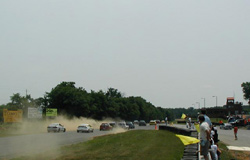
The pits are filled with the cars that have survived the weekend so far. A few drivers are forced to spectate; they don't have to wear Nomex any longer in the heat, but that's little consolation for missing a race. The "Start your engines!" cry goes out over the PA, and 84 cylinders fire in 21 cars, filling the paddock with the sound of several thousand small explosions per minute. The cars head off for their warm up lap, and then cruise around turn 10, heading for their designated starting positions as dictated by their qualifying times. Jedd Fahnestock's (#44) CRX rushes from the paddock to the pit lane, having missed the warm up lap. He will be able to join the race behind the last car. The cars sit for a moment, waiting to pounce at the green flag. When it drops, 21 cars go full throttle, front tires clawing for traction; the sound is glorious and deafening. It is immediately apparent that something is not right in the field. Frank DePew's (#00) Civic is unable to grab first gear, so he sits idle as the pack accelerates around him. The yellow flags come up and the cars behind #00 dodge left and right to avoid contact, some kicking up a cloud of brown dust as they tear into the dry earth off the track. Everyone makes it by cleanly, and soon DePew is underway as well. Jedd Fahnestock's silver CRX jumps out of the pit lane and joins the tail of the snake as they blaze off towards turn 1.
The results for the 4th race of the ECHC's inaugural season are: Jack Harris (#1) in H1 and overall; Adam Curpier (#45) in H2; Chris Brinson (#7) in H3; James Evans (#73) in H4; and, despite starting at the back of the pack, Jedd Fahnestock (#44) in H5. Neither of the H-Unlimited cars was able to run Sunday's race. There are no trophy girls for this race, or champagne; only points for those who placed well, some wear and tear on equipment, and another 20 laps of race experience. The drivers begin stowing their gear and putting their cars on trailers shortly after the race is over. There are real jobs to go to on Monday, the ones that pay for this expensive addiction to speed. Most of the drivers coordinate and communicate over the Internet, so Honda-Tech.com will be filled for at least a week with in-car video, opinions, some arguments, and good stories. July will be spent repairing what.s broken, restocking the wear items, and playing with configurations using the knowledge gained this weekend. Round 3 is in early August at Carolina Motorsports Park. And the ECHC guys already can't wait. COPYRIGHT 2002 Scott R. Lear |
||||||||||||||||||||||||||||||||||||||||